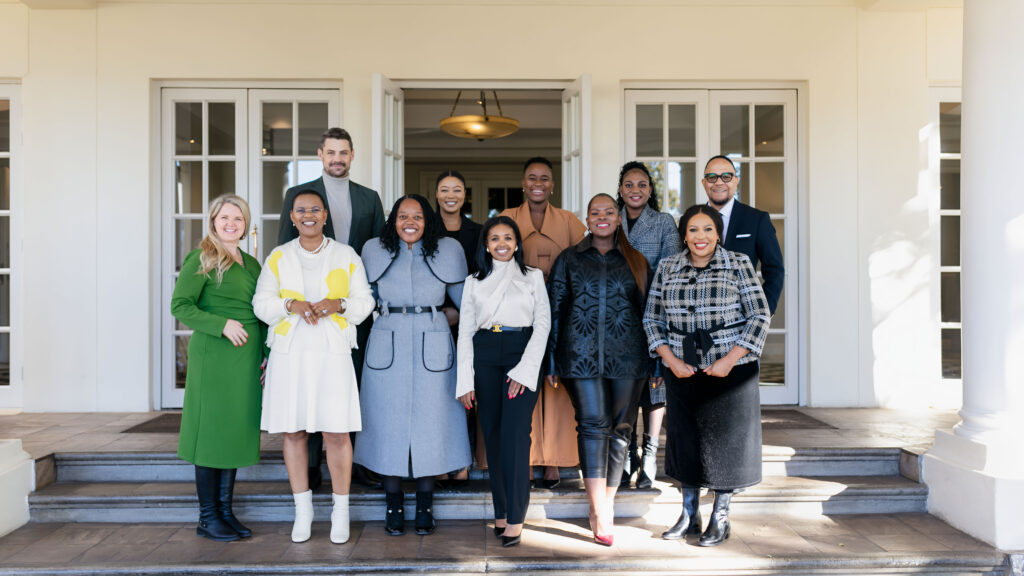
Amanda Dambuza’s work is a powerful reminder that true impact lives in what endures. As Founder and CEO of Uyandiswa Group, Dambuza has long challenged the status quo. First by rising through the ranks of traditional institutions and now by building systems that centre agility and real transformation. Her approach to leadership is about outcomes.
As a judge for the 2025 Veuve Clicquot Bold Woman Award, Amanda brings hard-earned insight into what boldness really means in business. In conversation, she speaks candidly about everything from the internal shifts women must make to lead sustainably to the systemic rewiring still required to turn visibility into power.
As someone who has navigated both executive boardrooms and entrepreneurial trenches, what internal shifts must women make (not just skill-wise, but psychologically) to lead boldly and sustainably in today’s volatile business climate?
The first critical shift is moving from a mindset of proving to one of owning. Too often, women exhaust themselves trying to validate their competence, operating under the unspoken pressure of having to work twice as hard to earn their seat at the table. Sustainable leadership begins when they stop negotiating their worth and instead declare it with unshakable confidence. This shift requires daily reinforcement—whether through affirmations, boundary-setting, or simply pausing before entering high-stakes spaces to remind themselves, “I belong here.”
Another essential transformation is releasing the grip of perfectionism in favour of strategic excellence. Many women hold back from speaking up, taking risks, or making decisive moves because they fear being wrong or incomplete. But in a fast-moving, unpredictable business environment, waiting for flawless execution means missing opportunities. Progress—not perfection—fuels innovation. Leaders who embrace this shift give themselves permission to act on intuition, share half-formed ideas, and iterate publicly, knowing that their voice has value even when it’s still evolving.
Equally important is the shift from apologising to advocating. Women often soften their language, downplay their contributions, or over-explain to avoid seeming aggressive. But leadership demands clarity, not contrition. Removing disclaimers like “just,” “sorry,” or “I might be wrong” from professional communication signals self-assurance and commands respect. This linguistic shift isn’t just about semantics—it’s a psychological realignment that reinforces authority.
Finally, women must move from the lone warrior mentality to becoming collaborative architects. Many female leaders, especially in male-dominated spaces, fall into the trap of overworking to prove they can handle everything alone. But sustainable influence isn’t built on individual heroics—it’s built through delegation, trust, and the ability to galvanise teams. Letting go of control and empowering others doesn’t diminish leadership; it amplifies it.
You’ve spoken about the power of shared experiences among women. In your view, what structural barriers persist despite our growing networks, and how can collective intelligence truly dismantle them, not just ease them?
Despite the proliferation of women’s business networks and mentorship schemes, female entrepreneurs continue to face deeply ingrained structural barriers that individual effort alone cannot overcome. The notorious funding gap persists, with women-led startups receiving a mere 2% of venture capital—a disparity rooted in biased risk assessment and homogenous investor networks. While peer support provides solace, true progress demands collective disruption: women mobilising capital through angel syndicates or stokvels, creating alternative funding platforms, and holding gatekeepers accountable through data-driven advocacy.
Similarly, the “double bind” of leadership expectations penalises ambitious women as “too aggressive” while framing collaborative approaches as “lacking authority”—a cultural script that requires industry-wide coalitions to redefine entrepreneurial success metrics. Even the burden of unpaid labour persists, with female founders disproportionately expected to champion diversity initiatives or mentor others without compensation.
Tackling these systemic issues requires more than resilience; it necessitates organised, strategic pressure to overhaul policies, investment criteria, and workplace norms. The path forward lies not in adapting to broken systems, but in rebuilding them through collective clout, where women’s pooled resources, shared intelligence, and uncompromising demands for equity become the levers of structural change.
You’ve led in institutions known for legacy systems and now run a company focused on transformation. What lessons from the rigidity of corporate culture have informed how you build agile, future-facing businesses today?
When I founded Uyandiswa, I knew for sure that I wanted to create my own system. Big companies love hierarchies, but all those layers just slow things down. I let my team make decisions without waiting for 5 levels of approval.
Corporate culture treats mistakes like scandals. But in the real world? Every “oops” is just a stepping stone. I test that wild idea and fix it as I go. There is no waiting until everything is ready because it never will be. Build it as you fly it. Flexibility is the paramount reason I left the corporate system, and this is extended to my team as well. No one has to ask for permission to handle their lives during work hours. I trust my team to deliver what is needed when it is due. How they go about it, is not something I care about, and no one is micromanaged. We share knowledge widely between departments, with partners, even (carefully) with competitors. Collaboration beats competition.
In a world where ‘resilience’ is often romanticised, what does responsible resilience look like for women entrepreneurs and how can we stop glorifying burnout in the name of ambition?
Responsible resilience for women entrepreneurs isn’t about grinding until you break, it’s about building a business that thrives without demanding your self-destruction as collateral. The myth that suffering equals success is especially toxic for women, who are already pressured to “do it all” with a smile. True resilience isn’t measured in sleepless nights or hustling through burnout; it’s about designing sustainable systems for your company and yourself. That means setting boundaries without guilt (no, you don’t need to answer emails at midnight), delegating before you’re drowning, and treating your well-being as non-negotiable infrastructure, not an afterthought. It’s recognising that rest, therapy, and saying “no” aren’t setbacks—they’re strategic tools that keep your ambition alive for the long haul.
The glorification of burnout isn’t ambition—it’s a rigged game. Women can rewrite the rules by rejecting the idea that exhaustion is a badge of honour. Celebrate revenue and recovery. Brag about profit margins and paid leave policies. Normalise “I’m scaling back to scale up” as a leadership strength. When women stop conflating suffering with success, we don’t just survive—we build businesses that endure because they’re fuelled by clarity, not caffeine and crisis mode. Real resilience doesn’t mean never bending; it means knowing you won’t break.
As we celebrate progress, how do we ensure that visibility for women in business doesn’t become symbolic, but translates into actual power, capital access and long-term influence?
As we applaud the growing visibility of women in business, we must confront the uncomfortable truth: recognition alone is not power. True progress requires dismantling the systemic barriers that keep women’s influence symbolic rather than substantive. It starts with capital access—moving beyond token female representation in pitch rooms to fundamentally reshaping investment criteria, challenging the biased risk assessments that see women-led ventures as “too niche” or “high-risk” despite their proven returns. Visibility must translate into board seats with voting power, not just advisory roles, and into ownership stakes, not just applause for being included.
We also need to reject the “first and only” trap—where one woman’s success is celebrated as enough—and instead demand critical mass. Real influence comes when women aren’t exceptions but architects: setting deal terms, leading mergers, and shaping industry standards. This requires intentional succession planning, sponsorship (not just mentorship), and holding institutions accountable for where money and decision-making authority truly land.
As a judge for this year’s Veuve Clicquot Bold Woman Award, I have seen first-hand how these awards can create visibility for women entrepreneurs by not only celebrating but also equipping them by opening doors, giving them the tools to scale and dare to dream bigger.
Finally, long-term influence hinges on legacy-building—women reinvesting in the next generation not just as role models but as gatekeepers rewriting the rules. That means funding female-founded funds, normalising non-linear career paths, and valuing collaborative leadership as much as competitive individualism. The goal isn’t just a seat at the table; it’s redesigning the table altogether. Progress isn’t counted in headlines—it’s measured in bank balances, equity stakes, and who gets to say “no” without consequence.
With your experience across governance, entrepreneurship and mentorship, how do you discern the difference between performative leadership and deeply rooted, impact-driven leadership, especially in awards spaces?
In the glittering world of business awards and leadership accolades, it’s becoming increasingly difficult to distinguish between genuine, impact-driven leadership and carefully curated performance. The key difference lies not in the spotlight moments, but in what happens when the cameras turn away. Performative leadership tends to flourish during awards season, with meticulously crafted narratives and photo ops, yet lacks tangible, sustained impact beyond the ceremony. These leaders often focus on personal brand-building—think viral TED Talks and press-friendly “firsts”—while their actual teams or industries see little meaningful change. In contrast, deeply rooted leadership demonstrates its worth through measurable outcomes that persist regardless of recognition: closed pay gaps, implemented policies that outlast trends, and team members who’ve genuinely progressed under their guidance.
The telltale signs become clearer when we examine consistency and motivation. Performative leaders often champion causes aligned with current headlines, while impact-driven leaders have long been doing the unglamorous work.
For those evaluating leadership in awards spaces, the scrutiny must go deeper than submission packets. Examine whether judging criteria prioritise real outcomes over compelling storytelling. Look beyond stage presence to financial commitments—does the leader’s investment portfolio or company practices align with their professed values? Most revealing are the unsolicited voices of their teams; employee retention rates, reviews, and organic advocacy from colleagues often tell a more truthful story. At its core, leadership that drives lasting change doesn’t require trophies to validate its existence—its impact is evident in the doors that remain open long after the awards ceremony ends, and in the people empowered to walk through them.
You founded Vastly Sage to create space for women beyond traditional mentorship. What are some uncomfortable truths you’ve encountered about how women unknowingly replicate exclusionary practices, and how do we unlearn them?
One uncomfortable truth is that women, even while breaking barriers, often unconsciously replicate the very exclusionary systems they’ve struggled against. Having internalised patriarchal norms, some adopt “queen bee” tendencies—gatekeeping opportunities from other women to protect their hard-won status, or mistaking toughness for leadership by dismissing softer skills as “unprofessional.” Others perpetuate homophily, mentoring or hiring those who mirror their own background (education, race, or class), leaving intersectional voices behind. There’s also the subtle compliance bias: downplaying feminist rhetoric to appease male-dominated spaces or labelling ambitious women as “difficult” while praising men for the same traits.
Unlearning this requires active discomfort. It means auditing our own biases—like assuming a candidate from disadvantaged background lacks “polish,” or conflating confidence with competence. It demands interrogating privilege.
The hardest reckoning is recognising that inclusion isn’t instinctive—it’s intentional. But when women wield influence to lift others without exception, we don’t just diversify the table—we redesign it. This is where platforms like the Veuve Clicquot Bold Woman awards are so successful at showcasing how women are re-designing the table and leaving a trail of impact behind, a true legacy attributable to Madame Clicquot herself.
Dambuza speaks about transformation, she builds it, funds it and more importantly, lives it. Her leadership refuses to perform for applause or conform to broken systems. Instead, she models what it looks like to lead with clarity, to scale with intention and to centre collective power over individual prestige. In every insight shared here is a challenge: own your voice without apology and design businesses that honour well-being as much as ambition.