Digitlab’s latest digital research, Insight 2026, has identified a clear and consistent pattern across South African businesses: marketing channel effectiveness changes materially as organisations scale, and misalignment between channel choice and organisational maturity is a growing source of wasted spend.
The study, based on responses from more than 350 businesses across start-ups, small businesses, and larger organisations, shows that smaller organisations achieve stronger returns from a narrow mix of owned, social, and direct-response channels. As organisations grow, effectiveness shifts toward broader, more integrated channel strategies — provided the supporting data, systems, and skills are in place.
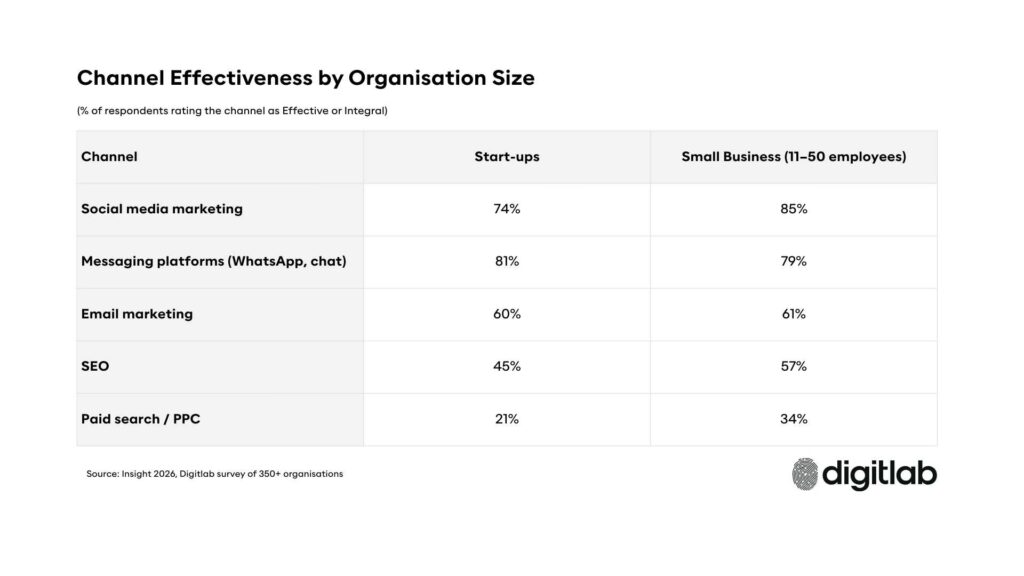
According to the research, 74% of start-ups and 85% of small businesses rate social media marketing as effective or integral to performance. Messaging platforms such as WhatsApp perform particularly strongly for early-stage businesses, with 81% of start-ups reporting them as effective. Email marketing remains consistently valuable across both segments, with roughly 60% reporting strong performance.
By contrast, more complex performance channels show a clear dependency on scale. Only 21% of start-ups rate paid search as effective, compared to 34% of small businesses, while SEO effectiveness increases from 45% at start-up level to 57% among small businesses.
“The data makes something very clear,” says Mike Saunders, CEO of Digitlab.
“Smaller organisations don’t lose because they lack channels — they lose when they adopt too many of them too early. Effectiveness comes from focus first, integration later.”
The cost of premature complexity
One of the most consistent risks identified in Insight 2026 is the early adoption of enterprise-style marketing strategies by small and mid-sized organisations. While tools such as CRMs, automation platforms, and multi-channel campaign stacks are widely available, the research shows that effectiveness lags far behind adoption.
Many SMEs report having systems in place without the operational maturity, data discipline, or internal skills required to extract value from them. This results in fragmented reporting, unclear attribution, and growing pressure to justify marketing spend — particularly in an environment of tightening budgets.
“Our research shows that copying enterprise marketing models without the underlying scale consistently leads to inefficiency,” Saunders adds. “It’s not that the tools don’t work — it’s that timing matters. Channel strategy has to evolve with the business, not with industry hype.”
Scale changes what ‘good‘ looks like
The findings reinforce that channel effectiveness is not static. What works at one stage of growth can underperform at another.
Start-ups and early-stage businesses benefit most from:
- Fast feedback loops
- Direct customer interaction
- Channels that reward responsiveness over complexity
As organisations grow, effectiveness shifts toward:
- SEO and paid media supported by attribution models
- CRM-led lifecycle management
- Integrated brand and performance strategies
This evolution is reflected not only in channel performance, but also in how success is measured. Start-ups continue to prioritise reach and engagement, while small businesses increasingly focus on lead volume, lead quality, and traffic sources that can be tied to revenue outcomes.
Core findings from Insight 2026
The research highlights four key conclusions:
- Channel effectiveness is scale-dependent
Smaller organisations perform best with fewer channels executed well. Complexity becomes effective only when scale supports it.
- Owned and social channels dominate early-stage performance
Social media, messaging, and email consistently outperform paid and technical channels for start-ups and small businesses.
- Premature enterprise thinking creates waste
Early adoption of complex stacks without data maturity leads to underperformance and budget pressure.
- The strongest strategies evolve deliberately
The most effective organisations adjust channel mix as they grow, rather than chasing trends or copying larger competitors.
A shift in how marketing decisions are made
As economic pressure forces organisations to justify spend more rigorously, the findings from Insight 2026 suggest a shift is underway. Marketing effectiveness is increasingly tied to strategic restraint rather than expansion — doing fewer things better, for longer, before adding complexity.
“The smartest organisations aren’t asking which channels are trending,” Saunders concludes.
“They’re asking which channels make sense for where they are right now — and that’s the difference between momentum and waste.”
Insight 2026 is Digitlab’s annual research study into marketing effectiveness, data maturity, and technology adoption across South African organisations. Supporting data tables and segment-level analysis are available on request.