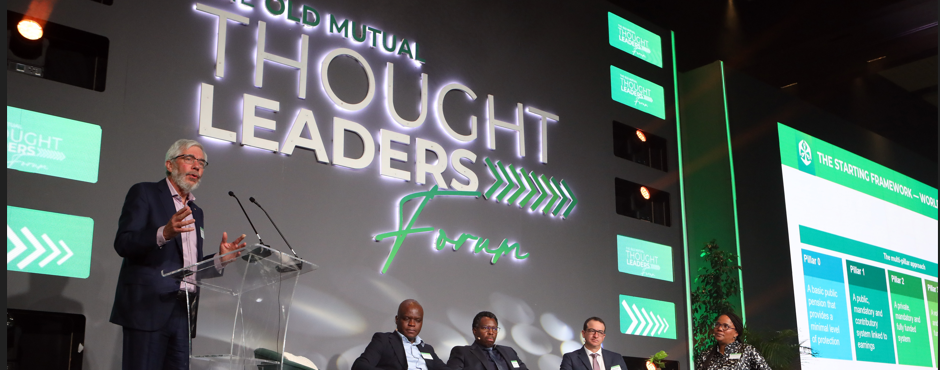
National Treasury estimates that only 94% of working South Africans will be able to retire comfortably. It’s an often-quoted statistic, supported by Old Mutual’s research into the local retirement system. Industry experts at the recent Old Mutual Thought Leaders Forum agreed that the challenge lies in improving retirement outcomes while expanding access to the retirement system. And the key to solving that lies in job creation.
‘Our country has made significant progress in our 30-year journey of freedom and democracy,’ Deputy Minister of Finance David Mabusa told the Old Mutual Thought Leaders Forum. ‘Many people who were historically excluded are now active participants in the economy. However, our journey is far from over. There are still too many people who are unemployed, who are unemployed and too many who live in poverty. Income and wealth inequalities persist, and millions of South Africans cannot retire with dignity, while millions cannot save for retirement at all. We have to grow the economy to address these problems.’
Chris Axelson, Acting Deputy Director-General of National Treasury’s Tax & Financial Sector Policy Unit, pointed to South Africa’s high unemployment rate (32.9% in Q1 2024). ‘Our main problem is that not enough people are employed,’ Axelson said. ‘You need employment; you need people in jobs to be able to save. They need an income. If you can fix the underlying causes, which is what Treasury is trying to do with its structural reforms – to increase employment – then you can immediately have more savings.’
Those reforms include the Two-Pot Retirement System, which came into effect on 1 September. The Two-Pot System introduces an element of mandatory retirement savings preservation. Previously, the average South African retirement fund member was only retiring with two to three times their annual salary. With the introduction of the Two-Pot Retirement System, Old Mutual projects that this will increase to around nine times – even if a member accesses their entire Savings pot during their lifetime.
Deputy Minister Mabusa described the Two-Pot System as ‘the latest in a series of comprehensive reforms implemented by the South African government to simplify and harmonise the pension system, incentivise patient savings, and increase the fairness of the retirement system’.
But while the Two-Pot System aims to improve retirement savings outcomes, it doesn’t address the issue of access to the retirement system. Unemployed people, freelancers, gig workers and people who work in the informal economy are still largely left to fend for themselves.
Are small businesses the answer? According to the Banking Association of South Africa, SMEs make up 91% of the country’s formalised businesses and employ about 60% of its labour force. Here, as in other emerging markets, small businesses are big employers, presenting a significant market for the retirement and broader employee benefits industry.
John Dludlu, Chief Executive Officer of the Small Business Institute, said that the industry must tailor solutions that meet the specific needs of SME owners and their employees. In an interview for Old Mutual Corporate’s Mindspace Thought Leaders Forum publication, Dludlu suggested two steps the retirement industry can take to address this. First, invest in truly understanding SME owners’ retirement needs; and, second, tailor solutions guided by these unique needs. ‘Designing solutions for a market that is misunderstood is as dangerous as fitting used car parts to a vehicle still under warranty,’ he said.

Research conducted by Old Mutual Corporate sought to do the former, looking at what South African SMEs offer as employee benefits. The 2024 Old Mutual Workplace Benefits Primary Research, powered by LIMRA, built on that to paint a clear picture of how the employee benefits industry in general (and the retirement industry in particular) can change to better service small businesses.
‘In 2023, 61% of all SMEs surveyed by Old Mutual Corporate said they have a retirement benefit fund for staff,’ said Nobesuthu Ndlovu, Director: SME at Old Mutual. ‘However, this differs according to turnover. Around 44% of companies earning between R7 million and R13 million a year offer retirement benefits, while only around 29% of companies earning in the lower bracket of R2 million to R7 million a year are able to do so.’
Why don’t SMEs offer core benefits to their staff? ‘Affordability is an obvious answer but it’s not the only answer,’ Ndlovu said. ‘Among small businesses (those employing less than 100 people), about a quarter said they have other business priorities – yet this is a significantly lower portion than the 40% of bigger businesses (250-plus employees) who say the same.’
Ndlovu points to the 13% of SMEs who say they simply don’t have enough employees. ‘The industry isn’t reaching them,’ she says. ‘There’s a gap in the market for cost-effective, flexible employee benefits offerings that speak to the needs of these small employers and their staff.’
The employee benefits industry can reach this largely-overlooked market by not treating small businesses like big businesses, said Dludlu. ‘Typically, both owners and employees of SMEs and family-owned firms make their own retirement provisions,’ he said. ‘It’s unfair to expect them to start emulating big business owners.’
Ndlovu called on brokers and intermediaries to help with this much-needed industry transformation. ‘A broker channel is important to penetrate SMEs,’ she said. ‘This is a deeply intermediated space, so brokers must understand the needs of SMEs, assist with administration and establish relationships. The implementation can also be seen as time-consuming and complex for SMEs, especially if they have limited to no HR resources to help guide and ensure compliance.’
Ultimately, Ndlovu concluded, the employee benefits industry as a whole can – and should – do more to create an enabling environment for SMEs. ‘Small businesses are often referred to as the lifeblood of the South African economy,’ she said. ‘It will be impossible to improve retirement outcomes in general unless we empower SMEs, both formal and informal, to become more sustainable.’
*Read the Mindspace Thought Leaders Forum publication HERE.